




The purchase or rental of real estate in Austria is always connected with a large number of legal details. One of the key instruments that guarantees transparency and security of transactions is the Grundbuch – a special state land register. It contains all official information about land plots, houses, apartments and the rights and restrictions associated with them.
Understanding what the Grundbuch is and how to use it is important both for buyers and sellers of real estate, as well as for investors, lawyers, and real estate agents.
What is the Grundbuch?
Grundbuch is the state land register of Austria, maintained by the courts. It is intended for documenting ownership rights, encumbrances, and other legal information regarding real estate.
Simply put, the Grundbuch is a “passport” for immovable property. If you want to find out who owns an apartment or a land plot, or whether it is subject to a mortgage or servitudes, it is the Grundbuch that provides official answers.
Its maintenance is regulated by the Austrian Land Register Act (Grundbuchsgesetz) and ensures the publicity of data – anyone can obtain an extract (Grundbuchauszug) upon payment of a small fee.
In addition, Austria has the Grundstücksdatenbank (GDB), which combines the Grundbuch and the cadastral map. There you can find not only owners but also exact boundaries of plots, their coordinates, and size. This is extremely important for architects, developers, and potential investors planning projects.
The register performs several functions:
-
- Legal — confirms ownership rights to immovable property as well as existing encumbrances on real estate.
-
- Informational — provides access to current data on real estate to anyone who needs it.
-
- Protective — prevents fraud, since ownership rights arise only after an entry has been made in the Grundbuch.
Why is the Grundbuch needed?
-
- Verification of the owner — a guarantee that the seller truly has the right to sell the property.
-
- Detection of encumbrances — the possibility to find out about the existence of mortgages, arrests, or servitudes (this is shown in Section C).
-
- Completion of the transaction — ownership rights pass to the buyer only after the entry has been made.
-
- Mortgage and lending — banks require an extract to assess risks and register their collateral rights precisely in C-Teil.
Basic principles of the Grundbuch
The Austrian system is based on three fundamental rules:
-
- Principle of publicity: the data of the Grundbuch is open, and any person can obtain it by paying a small court fee.
-
- Principle of registration: ownership rights or mortgages arise only after the official entry into the register.
-
- Principle of public trust (Vertrauensprinzip): the information in the register is considered reliable and protects the bona fide purchaser.
Thanks to these rules, the real estate market in Austria is considered one of the most transparent in Europe.
Structure of entries in the Grundbuch
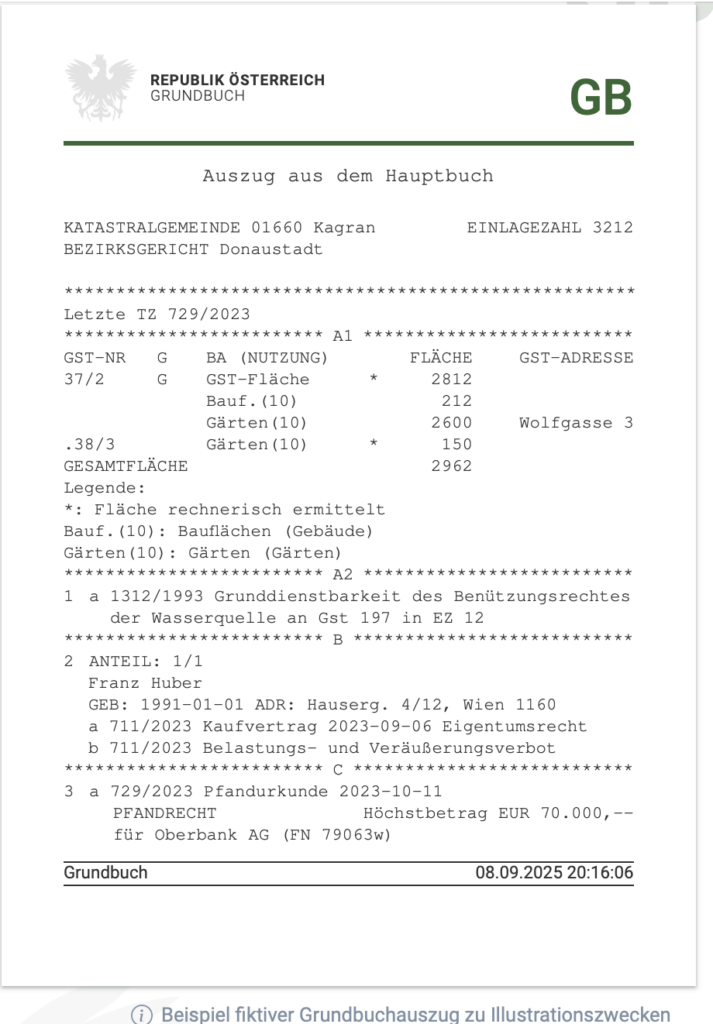
Each real estate object has its own main land register (Grundbuchseinlage), which consists of several parts:
-
- A-Teil (Hauptbuchblatt – main sheet). Contains basic information about the property: address, cadastral number, size of the land plot, description of buildings.
-
- B-Teil (Eigentumsblatt – ownership sheet). Here the owner (or co-owners) of the property is indicated, the size of ownership shares, as well as the legal basis for acquiring the right (for example, purchase, inheritance).
-
- C-Teil (Lastenblatt – encumbrance sheet). This part specifies all restrictions and encumbrances: mortgages, pledges, servitudes (right of way or passage), tenancy rights, prohibition of sale, etc.
This structure is uniform for the entire country, so any extract looks the same and is understandable. From it, you can immediately see: who is the owner, which rights restrict the use of the property, and whether it is free from debts and mortgages (see sample extract from the Grundbuch).
How to obtain an extract from the Grundbuch?
An extract from the register (Grundbuchauszug) can be ordered in several ways:
-
- through the court (Bezirksgericht) – the officially authorized body;
-
- through a notary or lawyer – the most common option in case of transactions;
-
- online through electronic platforms (for example, via the JustizOnline system or Grundbuchauszug ONLINE).
The cost of the extract is usually a few euros. The document can be obtained in paper or electronic form, and it has the same legal force.
Example of practical use
Situation 1: a person plans to purchase an apartment in Vienna. The real estate agent shows the property at an attractive price. To make sure the deal is “clean,” the lawyer orders an extract from the Grundbuch.
As a result, it turns out that the owner is a private person, but Section C indicates that the apartment is under a bank mortgage. This means that during the purchase it is necessary to take into account the owner’s obligations to the bank: either he repays the debt before the transaction, or the bank agrees to remove the encumbrance after payment.
Situation 2: an investor buys a land plot for construction. In C-Teil a servitude is discovered – the neighbor’s right to use the access road. This limits the possibilities of development, and without this information, the buyer could have suffered financial losses.
How are changes made to the Grundbuch?
Any changes related to rights to real estate are subject to entry into the register. This is done through an application (Antrag) submitted by a notary or lawyer to the competent court.
For example:
-
- when buying an apartment – the purchase agreement is attached,
-
- in case of inheritance – the court decision on the right to inheritance,
-
- in case of mortgage – the agreement with the bank.
The entry in the Grundbuch has constitutive significance – that is, ownership rights arise only after entry into the register.
Cost and deadlines
-
- Court fee for registration of changes — 1.1% of the value of the property upon purchase (temporarily – until 2026, when buying real estate worth less than 500,000 euros, the court fee is not charged).
-
- If a mortgage is registered, an additional 1.2% of its amount is charged.
-
- Time frame for making changes — from several weeks to several months, depending on the court’s workload.
These expenses should be taken into account when planning a transaction.
Conclusion
The Grundbuch is the foundation of the real estate system in Austria. It guarantees transparency, security of transactions, and protection of owners’ rights.
Possessing information about how to use the register makes it possible to: avoid risks when buying, correctly formalize rights and have legal guarantees of property protection.
Therefore, before any real estate transaction, it is worth ordering an extract from the Grundbuch and consulting a lawyer. This is a small investment that can save you significant money and nerves.


