




Selling an apartment in Vienna is not just about posting a listing and waiting for a buyer. It is a multi-stage process that includes proper property valuation, document preparation, tax payment, and legal completion of the transaction. According to the Austrian Economic Chamber (WKO), housing prices in Vienna vary significantly depending on the district — from approximately 3,500 euros per square meter in remote areas to over 10,000 euros in the city center. If you are planning to sell your apartment, this guide will help you through the entire journey from preparation to receiving funds in your account.
Before putting your apartment up for sale, it is important to understand that the Austrian real estate market has its own specifics. Buyers here thoroughly check properties, and the legal purity of the transaction is a mandatory condition for registering ownership in the land register. That is why preparation for sale can take from several weeks to several months, depending on the state of your documentation and the market situation. Read more about the specifics of the real estate market in Austria on our blog.
First Step: Determining the Real Value of the Apartment
Proper property valuation is the foundation of a successful sale. An overpriced apartment scares off potential buyers, while an underpriced one means direct financial losses for you. In Austria, there are several ways to determine the market value of an apartment, and it is best to use them in combination.
The most accurate method is to order a professional appraisal from a certified property valuer. The cost of this service ranges from 500 to 1,500 euros depending on the area and complexity of the property, but this document will be useful not only for determining the price but also for negotiations with buyers and banks if the buyer is taking out a mortgage.
The VigoImmobilien team conducts a professional market value analysis of your apartment based on current transaction data in your area, the condition of the property, and current market trends. This allows you to set an optimal price that will attract buyers without undervaluing the real worth of your property.
If you want to get an idea of prices on your own, use the official property price index from WKO, which publishes average figures by district.
The price of an apartment in Vienna is primarily influenced by its location — the difference between the prestigious 1st district Innere Stadt and the remote 22nd district Donaustadt can be 100% or more.
Also important are:
-
- building type (Altbau or new construction)
-
- floor
-
- availability of elevator, balcony, or terrace
-
- renovation condition
-
- energy efficiency
You can learn more about the specifics of different Vienna districts in our real estate section.
Documents Required for Sale
Austrian legislation requires the seller to have a complete set of documents even before active viewings begin. The main one is an extract from the land register Grundbuch, which confirms your ownership and shows all encumbrances on the property — mortgages, easements, right of way (Wegerecht), etc. You can order an extract online through the JustizOnline system for a symbolic fee of a few euros.
Equally important is the building energy certificate (Energieausweis), which has been mandatory since 2012 when selling any property in Austria. This document is valid for 10 years. The absence of an energy certificate can result in a fine of up to 1,450 euros according to the Energy Certificate Act (EAVG 2012). If your energy certificate is outdated or missing, order one from a certified energy auditor.
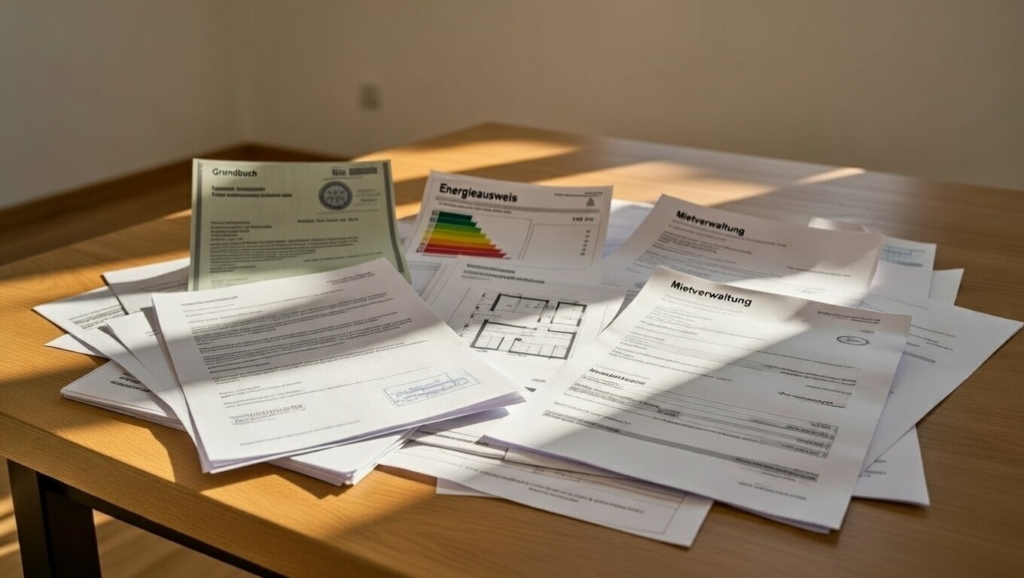
In addition, you will need:
-
- apartment floor plan with area specified
-
- building management agreement (Hausverwaltung)
-
- recent utility bills and reserve fund statements
-
- minutes of co-owners meetings from recent years
If the apartment is rented out, you must also have a copy of the lease agreement — the buyer has the right to know about the tenant’s rights, which may restrict the use of the property.
Read about the specifics of selling rented property on our blog.
Tax on Profit from Property Sale
One of the most important aspects of selling an apartment in Vienna is taxation. Since April 1, 2012, Austria has had a tax on profit from property sale (Immobilienertragsteuer, or ImmoESt), which amounts to 30% of the difference between the purchase price and the sale price.
Calculation example: Alexander bought a two-room apartment in the 10th district Favoriten in 2018 for 280,000 euros. In 2026, he plans to sell it for 360,000 euros. His profit is 80,000 euros, and the tax is 24,000 euros (30% of the profit). It is important to remember that acquisition costs can include not only the apartment price but also additional purchase costs (Nebenkosten): notary services, property transfer tax, agent commission — this will reduce the tax base.
Please note: the ImmoESt tax calculation can be more complex if the apartment was purchased before 2002 — in this case, different rules apply (the so-called “Altvermögen”). We recommend consulting with a tax advisor.
However, there are important exceptions when no tax is paid at all:
First, this is the main residence exemption (Hauptwohnsitzbefreiung): if you lived in the apartment as your main address for at least 2 years continuously from the time of purchase OR 5 years within the last 10 years before the sale, and upon sale you are giving up this main residence.
Second, this is the exemption for self-built housing (Herstellerbefreiung), if you built the house yourself and did not rent it out during the last 10 years.
Detailed information about these exceptions can be found on the official Austrian portal.
Choosing a Sales Strategy: On Your Own or with an Agent
Every seller faces the question: is it worth hiring a professional real estate agent, or can you sell the apartment on your own? Both options have their advantages and disadvantages, and the choice depends on your experience, time, and willingness to handle negotiations.
Selling on your own allows you to save on the agent’s commission. However, you will have to post listings on platforms like willhaben.at or immoscout24.at yourself, organize viewings, conduct negotiations, and coordinate work with the notary. For people without real estate experience, this can be a serious challenge, especially if buyers try to drive down the price or discover unexpected problems with documents.
Working with a professional agent means that all these tasks are handled by a specialist. A good agent will not only find buyers but also conduct a preliminary check of their financial ability to pay, organize legal support, and help with negotiations. This is especially important for foreigners selling property in Vienna — the language barrier and lack of knowledge of local details can significantly complicate the process.
The VigoImmobilien team has many years of experience working with clients from different countries and can support the transaction from valuation to receiving funds.
The Process of Closing the Deal and Transferring Ownership
When the buyer is found and the price is agreed upon, the legal completion of the transaction begins. In Austria, the property purchase agreement (Kaufvertrag) is drawn up by a notary or lawyer, and it must be notarized for subsequent registration in the Grundbuch. The cost of notary services is usually 1-3% of the transaction price and is traditionally paid by the buyer.
After signing the agreement, the buyer pays the property transfer tax (Grunderwerbsteuer) of 3.5% of the price and the land register registration fee (1.1%). According to a decision by the Austrian parliament, buyers may be exempt from the registration fee if they are purchasing housing to meet their own residential needs — this benefit is valid until July 1, 2026.
Important point: funds for the apartment are usually not transferred directly to the seller but are placed in a trust account (Treuhandkonto) of the notary or lawyer. The money is transferred to the seller only after successful registration of the buyer’s ownership in the Grundbuch, which takes from 2 to 6 weeks. This protects both parties from risks: the buyer knows that their money will not disappear before obtaining ownership, and the seller receives a payment guarantee.
Conclusion
Selling an apartment in Vienna requires careful preparation, but with the right approach, it can be done without unnecessary problems and financial losses. The key steps are a realistic valuation, preparation of a complete set of documents, understanding of tax obligations, and choosing reliable partners for legal support of the transaction.
If you are planning to sell your apartment in Vienna and want to receive professional consultation or assistance at every stage of the transaction, the VigoImmobilien team is ready to help. We know all the details of the Austrian market and provide transparent support from the first valuation to receiving funds in your account.
Contact us for a free initial consultation.


